

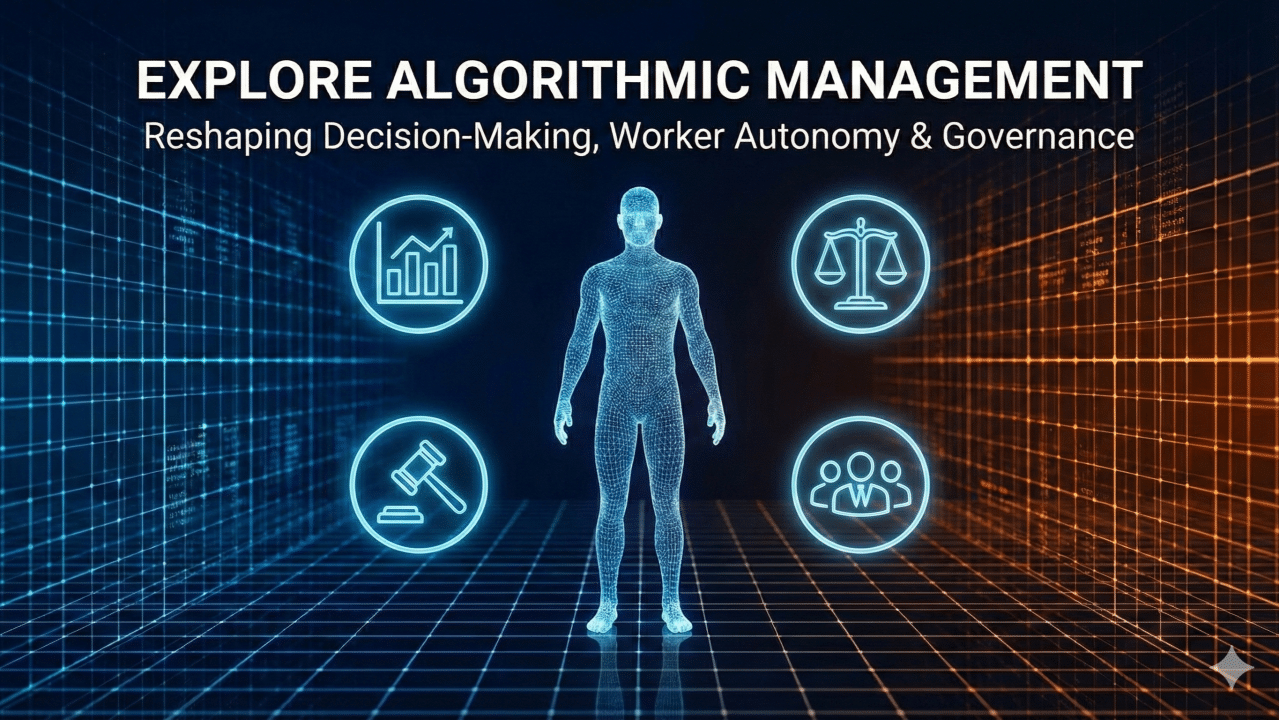
Explore how algorithmic management reshapes decision-making, worker autonomy, and governance from finance, legal, and HR team perspectives
As organizations increasingly delegate managerial tasks to AI-driven systems, algorithmic management is transforming how work is assigned, evaluated, and controlled. This shift carries profound implications for productivity, labor rights, and organizational culture, requiring economists, lawyers, and HR professionals to rethink efficiency, accountability, and workforce engagement in the digital era.
By Susana Taboas

Susana Taboas, economist and co-founder of Crypto ID. Graduated from PUC-Rio, with executive specialization programs at Harvard and INSEAD
Introduction
As the digital economy evolves, managerial functions long held by human supervisors are increasingly delegated to algorithmic systems. This transition — broadly described as algorithmic management — carries significant implications for organizational efficiency, worker autonomy, and institutional accountability. The phenomenon has been extensively discussed in academic research, notably in “Algorithms at Work: The New Contested Terrain of Control,” a widely cited article by Katherine C. Kellogg, Melissa A. Valentine, and Angèle Christin published in the Academy of Management Annals – (waim.network).
Drawing on this foundational work and recent empirical evidence from organizations such as the Organization for Economic Co-operation and Development (OECD), this article explores the economic, legal, and human resource implications of algorithmic management in contemporary workplaces. It also connects these insights to the broader debate on the governance of automated systems, including reflections introduced in “Meu chefe é um robô”, a recent article that investigates how algorithmic systems have become, in fact, supervisors.
The Scope of Algorithmic Management
Algorithmic management can be broadly defined as the delegation of managerial tasks — including task allocation, performance evaluation, scheduling, and disciplinary action — to automated systems. These systems operate by collecting real-time data and applying decision rules, often informed by machine learning, to execute decisions that traditionally required human judgment.
In their 2020 article, Kellogg, Valentine, and Christin conceptualize this shift through a framework they describe as the “new contested terrain of control.” They outline how algorithmic technologies reshape organizational control by directing, evaluating, and disciplining workers in ways that differ fundamentally from classical bureaucratic management.
Economic Impacts
From a productivity standpoint, the promise of algorithmic management is substantial. Organizations adopting these systems often report improved decision quality, greater operational speed, and enhanced consistency across managerial processes. Findings from a 2025 OECD employer survey indicate that a majority of managers using algorithmic tools perceive improvements in their own decision quality and satisfaction, highlighting potential benefits for organizational efficiency.
However, these economic benefits are accompanied by emerging concerns. OECD evidence shows that managers frequently report trustworthiness issues, such as unclear accountability for algorithmic decisions, limited traceability of decision logic, and concerns over worker well-being. These issues underscore the tension between efficiency gains and broader organizational resilience. For Economists and HR professionals, such evidence signals that algorithmic systems cannot be evaluated solely through productivity metrics; they also affect labor dynamics, including workforce morale, psychological safety, and long-term engagement.
Legal and Regulatory Dimensions
The shift toward algorithmic management raises pressing legal questions, particularly regarding accountability and regulatory compliance. In many jurisdictions, traditional labor law frameworks were not designed to address decisions made by automated systems, leaving gaps in the protection of worker rights.
Recent policy debates in the European Union illustrate this challenge. Lawyers are requesting for more robust rules to ensure transparency, human oversight, and data privacy in algorithmic employment decisions—including hiring, performance evaluation, and disciplinary actions. These proposals seek to align algorithmic practices with the principles of fairness and non-discrimination enshrined in existing labor and data protection laws.
For legal professionals, effective governance requires not only regulatory updates but also mechanisms for algorithmic explainability and due process. Workers must be informed when systems are used to make decisions about their employment and must have access to meaningful avenues to contest those decisions.
Human Resources and Organizational Behavior
From an HR team perspective, algorithmic management challenges core assumptions about workforce engagement and organizational culture. While automated systems can standardize processes, they may also inadvertently diminish employee autonomy and contextual judgment — elements traditionally associated with job satisfaction and retention.
Academic literature suggests that algorithmic control can reduce job autonomy and increase stress when workers lack influence over the design and implementation of these systems. Furthermore, research indicates that algorithmic tools may reinforce surveillance practices that risk infringing upon worker privacy and collective bargaining power. Human resource leaders must, therefore, integrate algorithmic systems with participatory governance structures that include worker consultation and impact assessments. Only through such integration can organizations mitigate adverse effects while harnessing the potential benefits of AI in workforce management.
Towards Responsible Governance of Algorithmic Management
The integration of algorithmic systems into managerial roles presents a dual imperative: to harness technology’s efficiency gains while maintaining ethical and legal norms that protect workers and organizational integrity. This requires a shift from treating algorithms as neutral operational tools to recognizing them as decision-making agents embedded within social and legal contexts.
Reflections on the article “Meu chefe é um robô” — which documents how algorithms have assumed managerial functions across platform work landscapes — highlight the urgency of this shift. As emphasized in a contemporary research by Herbert Salles, the political and social implications of algorithmic control, workplace governance frameworks must evolve to ensure accountability, transparency, and fairness.
Policy frameworks should mandate algorithmic impact assessments and human oversight mechanisms. Simultaneously, organizations should develop algorithmic literacy among managers and workers to ensure all stakeholders understand how these systems operate.
Conclusion
Algorithmic management represents a fundamental transformation in how work is organized, evaluated, and controlled. For economists, lawyers, and HR professionals, this transformation presents both opportunities and risks.
While these systems can improve operational efficiency, unchecked deployment can undermine accountability and worker autonomy. Bridging this divide requires interdisciplinary approaches that combine technical understanding with ethical, legal, and organizational insights.
By situating algorithmic management within broader debates about governance and institutional accountability, professionals can develop more resilient frameworks that ensure technological progress aligns with human dignity and organizational justice.
Quando o chefe é um algoritmo: gestão, poder e a nova arquitetura do trabalho
Sobre Susana Taboas

Susana Taboas | COO – Chief Operating Officer – CryptoID. Economista com MBA em Finanças pelo IBMEC-RJ e diversos cursos de extensão na FGV, INSEAD e Harvard University. Durante mais 25 anos atuou em posições no C-Level de empresas nacionais e internacionais acumulando ampla experiência na definição e implementação de projetos de médio e longo prazo nas áreas de Planejamento Estratégico, Structured Finance, Governança Corporativa e RH. Atualmente é Sócia fundadora do Portal Crypto ID e da Insania Publicidade.
Leia outros artigos escritos por Susana.
Acesse o Linkedin da Susana!

Crypto ID stands at the forefront of the global digital transformation, delivering high-level analysis on the critical pillars of the digital economy: Cybersecurity, Digital Identity, Cryptography, Biometrics, and Blockchain.
For over more than a decade, we have shaped the conversation around digital trust, providing the market with the insights needed to navigate an increasingly complex security landscape. We believe that trust is not just a concept – it is the foundational currency of the digital future.
By aligning your brand with Crypto ID, you are not just advertising; you are championing the technological innovations that power secure, frictionless transactions between businesses and global citizens.
More about the International News
Acompanhe o melhor conteúdo sobre Inteligência Artificial publicado no Brasil.